AI Development Infrastructure
AI Development Infrastructure
Small edge models depend on high-quality training data for their performance, and safety validation requires evaluation data with broad coverage. We build AI development infrastructure that supports both, integrating automated annotation, data retrieval using natural language or image queries, generative AI–based data augmentation, and cloud-based data management pipelines into a single system. The result is AI development that is more efficient and delivers higher quality.

Key Techniques
- Automated annotation for 2D/3D object detection using foundation models
- Video retrieval systems with natural language or image queries
- Driving scene tagging and captioning with vision-language models (VLMs)
- Editing and augmenting existing scenes with world models, and CG-to-photorealistic conversion
- Data management pipelines built on AWS
FEATURES
Automated Annotation with Foundation Models
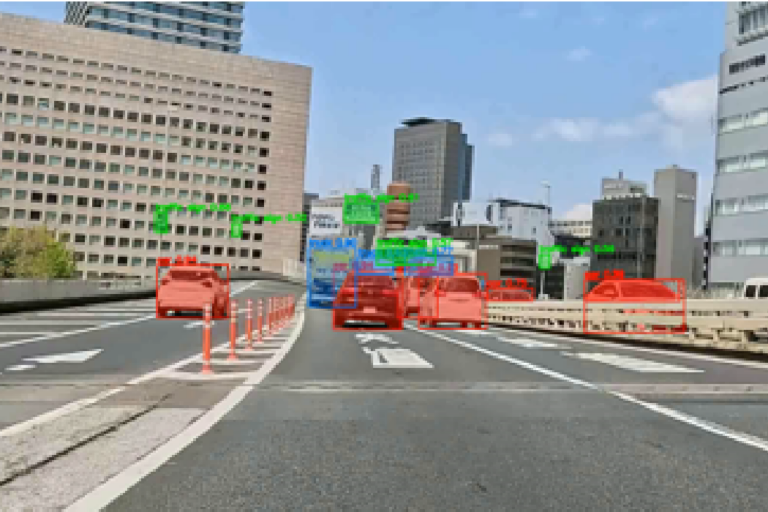
We build automated annotation pipelines for 2D/3D object detection based on open-vocabulary foundation models. By automating labeling work that typically depends on manual effort, we efficiently prepare the high-quality data needed to train small models for edge devices. We also use CLIP-based retrieval systems to efficiently find failure and corner cases.

Data Augmentation with Generative AI
We use generative AI to supplement traffic signs and scenes that are often underrepresented in datasets, improving data coverage. We also edit and augment existing scenes using world models. By generating variations in conditions such as weather, time of day, and traffic signs, we enrich both training and evaluation data.

Cloud-Based Data Management Pipelines
Uploading collected data automatically triggers each processing step, including lens distortion correction, anonymization (such as face and license plate blurring), labeling, and embedding generation. GPU instances are selected and launched on demand to match model size, keeping computing costs to a minimum. Integrated with data retrieval systems that support natural language and metadata queries, the pipeline streamlines the training and evaluation cycle.